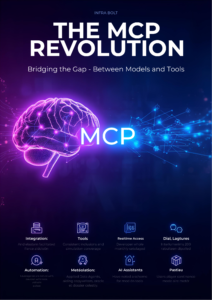
Artificial Intelligence is evolving rapidly, but one of the biggest challenges in AI systems has been connecting AI models with real-world tools and data sources. The MCP revolution is transforming how AI models interact with external systems, making them more powerful, flexible, and useful for real-world application
In this blog, we will explore what MCP is, why it matters, and how it is bridging the gap between AI models and tools.

What is MCP (Model Context Protocol)?
Model Context Protocol (MCP) is an open standard that enables AI models to communicate with external tools, applications, and data sources in a structured way. Traditionally, AI models operate in isolation. They generate responses based only on the data they were trained on or the prompts given to them. However, modern applications require AI to interact with databases, APIs, software tools, and real-time information.
Simple Example
Imagine asking an AI assistant:
“Check my calendar and schedule a meeting tomorrow at 10 AM.”
Without MCP, the AI might only provide suggestions.
With MCP, the AI can:
- Access your calendar
- Check available slots
- Schedule the meeting automatically
This transforms AI from a simple text generator into an intelligent assistant that can perform real tasks.
Why MCP is Important
The need for MCP arises because modern AI applications require seamless integration between models and tools.
Here are some key reasons why MCP is important.
-
Better Integration with Tools
MCP allows AI models to connect with tools such as:
- Databases
- Web services
- CRM platforms
- Email systems
- Development tools
This means AI can perform actions instead of only giving answers.
-
Real-Time Data Access
AI models are often limited by their training data. MCP enables models to access live data from external systems, making responses more accurate and up to date.
For example:
- Checking stock prices
- Fetching weather information
- Accessing customer data
-
Standardized Communication
MCP provides a standard protocol for communication between models and tools. This reduces the complexity of integrating AI into applications and helps developers build scalable systems.
-
Improved Automation
By connecting AI models with tools, MCP allows businesses to automate workflows such as:
- Customer support
- Data analysis
- Marketing automation
- Software development tasks
How MCP Works
MCP works by creating a structured communication layer between AI models and external systems.
The typical MCP architecture includes three main components.
-
AI Model
The AI model understands user requests and determines what actions are needed.
-
MCP Server
The MCP server acts as the communication bridge between the model and external tools.
- Receives requests from the model
- Identifies the required tool
- Sends commands to the tool
- Returns results to the model
-
External Tools
These are the services or applications that perform the actual tasks.
Examples include:
- Databases
- APIs
- File systems
- Business software
- Cloud services
Real-World Applications of MCP
The MCP revolution is enabling many powerful use cases across industries.
AI-Powered Customer Support
AI assistants can access CRM systems, check customer information, and resolve issues automatically.
Intelligent Software Development
Developers can connect AI with:
- Code repositories
- Testing tools
- Deployment systems
This allows AI to help with coding, debugging, and deployment workflows.
Data Analysis and Business Intelligence
With MCP, AI can retrieve data from databases, analyze it, and generate insights in real time.
Businesses can use this to:
- Track performance metrics
- Monitor sales data
- Generate reports automatically
Smart Productivity Assistants
AI assistants can interact with tools like:
- Email platforms
- Calendars
- Project management tools
This helps automate daily tasks and increase productivity.
Benefits of MCP
The MCP revolution offers several important advantages.
-
Flexibility
Developers can easily connect AI models with different tools and services.
-
Scalability
Applications can grow without rebuilding integrations.
-
Improved User Experience
Users get actionable results instead of static responses.
-
Faster Development
Standard protocols reduce the time needed to build AI-powered applications.
Challenges of MCP
Although MCP is powerful, it also comes with some challenges.
Security and Privacy
When AI interacts with external tools, protecting user data becomes critical.
Integration Complexity
Organizations must ensure their systems are compatible with MCP.
Reliability
The performance of AI applications depends on the reliability of connected tools and APIs.
The Future of MCP
It is about smarter systems that can interact with the world.
MCP is expected to play a major role in building:
- Autonomous AI agents
- Advanced productivity assistants
- Intelligent enterprise systems
As more tools adopt MCP standards, AI will become more capable of performing complex tasks across different platforms.
Conclusion:
The MCP revolution is transforming the way AI systems operate by bridging the gap between models and tools. Instead of working in isolation, AI models can now interact with external applications, access real-time data, and perform meaningful actions.
As businesses continue to adopt AI-driven solutions, MCP will become a key technology that enables smarter automation, better integrations, and more powerful AI applications. Grab your opportunity with GSInfotekh in our upcoming training sessions in your career-building program.