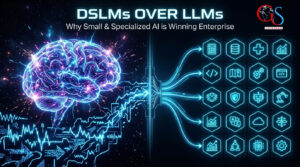
DSLMs Over LLMs: Why “Small and Specialized” is Winning the Enterprise
Artificial Intelligence is evolving fast, but not always in the direction people expected. While Large Language Models (LLMs) once dominated the conversation, a new trend is emerging—DSLMs over LLMs. Enterprises are increasingly shifting toward Domain-Specific Language Models (DSLMs) because they offer precision, efficiency, and control that generalized models often lack.
This shift is not just a trend; it’s a strategic decision driven by real business needs.
What Are DSLMs?
Domain-Specific Language Models (DSLMs) are AI models trained for a particular industry, function, or dataset. Unlike LLMs, which are trained on vast and diverse internet data, DSLMs focus on a narrow scope.
For example:
- A healthcare DSLM trained only on medical records
- A finance DSLM focused on compliance and transactions
- A customer support DSLM tailored to company FAQs
This specialization is the core reason behind the rise of DSLMs over LLMs.
Why Enterprises Are Choosing DSLMs Over LLMs
1. Higher Accuracy in Specific Domains
LLMs are generalists—they know a little about everything but may lack depth in critical areas. DSLMs, on the other hand, are experts.
When accuracy matters (like in healthcare or finance), DSLMs over LLMs becomes the obvious choice because they reduce irrelevant or incorrect outputs.
2. Better Data Privacy and Security
Enterprises deal with sensitive data. Using large external models can raise concerns about data leakage.
DSLMs can be:
- Hosted on-premise
- Trained on private datasets
- Fully controlled internally
This makes DSLMs over LLMs a safer option for regulated industries.
3. Lower Cost and Resource Usage
LLMs require massive infrastructure—high GPU usage, large memory, and expensive APIs.
DSLMs are:
- Smaller in size
- Faster to run
- Cheaper to maintain
From a business perspective, DSLMs over LLMs significantly reduces operational costs while maintaining performance.
4. Faster Performance and Latency
Speed matters in real-time applications like chatbots, fraud detection, or recommendation systems.
Because DSLMs are lightweight:
- They respond faster
- They consume fewer resources
- They scale more efficiently
This performance advantage strengthens the case for DSLMs over LLMs in production environments.
5. Easier Customization and Control
LLMs are often “black boxes.” Customizing them for specific needs can be difficult and expensive.
DSLMs allow:
- Fine-tuned behavior
- Business-rule alignment
- Controlled outputs
This flexibility is another strong reason why companies prefer DSLMs over LLMs.
Real-World Enterprise Use Cases
Enterprises are already applying DSLMs in practical ways:
- Customer Support: Faster, more accurate responses based on company data
- Healthcare: Diagnosis assistance using domain-trained models
- Finance: Fraud detection and risk analysis
- Legal: Contract analysis with high precision
In all these cases, the shift toward DSLMs over LLMs is driven by the need for reliability and relevance.
Challenges of DSLMs
While DSLMs offer many advantages, they are not perfect:
- Limited general knowledge
- Requires domain-specific training data
- Needs ongoing maintenance
However, for enterprises, these trade-offs are often acceptable compared to the risks of using large, generalized models.
The Future: Hybrid AI Systems
The future isn’t necessarily about replacing LLMs entirely. Instead, enterprises are moving toward hybrid systems:
- LLMs for general reasoning
- DSLMs for specialized tasks
Still, when it comes to core business operations, the preference for DSLMs over LLMs continues to grow.
Conclusion
The AI landscape is shifting from “bigger is better” to “smarter is better.” Enterprises are no longer chasing massive models—they are prioritizing efficiency, accuracy, and control.
That’s why DSLMs over LLMs is more than a trend—it’s a strategic evolution in how businesses adopt AI.
Small, specialized models are proving that focus beats scale when it truly matters.