AI is Eating Software: From “Writing Code” to “Expressing Intent”
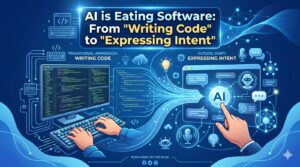
The phrase AI is Eating Software is no longer just a trend—it’s a reality reshaping how we build technology. Traditionally, software development required developers to write thousands of lines of code. Today, AI is changing that paradigm. Instead of manually coding every detail, developers can now simply express what they want, and AI handles the execution.
This shift from “writing code” to “expressing intent” is redefining the entire software industry.
The Evolution of Software Development
In the past, building software meant deep technical expertise, long development cycles, and constant debugging. Developers had to think in terms of syntax, frameworks, and infrastructure.
But now, AI is Eating Software by abstracting these complexities. Tools powered by AI can generate code, suggest improvements, and even build complete applications based on simple instructions.
This evolution is not just about speed—it’s about accessibility.
From Writing Code to Expressing Intent
The biggest transformation happening today is the shift toward intent-driven development.
Instead of saying:
“Write a function in Java to sort an array”
Developers now say:
“Create a fast and efficient sorting solution for this dataset”
AI understands the intent and delivers the result.
This is where AI is Eating Software becomes truly powerful. It removes the barrier between ideas and execution, allowing creators to focus on what they want rather than how to build it.
Why This Shift Matters
When AI is Eating Software, it impacts multiple areas:
- Speed: Development cycles become significantly shorter
- Productivity: Developers can focus on higher-level problems
- Innovation: More people can build software without deep coding knowledge
- Scalability: Solutions can be created and iterated faster than ever
This shift democratizes software development, making it accessible to entrepreneurs, designers, and domain experts.
The Rise of AI-Powered Development Tools
Modern tools like AI code assistants, no-code platforms, and autonomous agents are driving this change.
These tools:
- Generate code from natural language
- Debug and optimize automatically
- Build UI/UX with minimal input
As a result, AI is Eating Software by reducing the need for manual intervention and making development more intuitive.
Challenges and Considerations
While the transformation is exciting, it comes with challenges:
- Reliability: AI-generated code may need validation
- Security: Automated systems can introduce vulnerabilities
- Dependency: Over-reliance on AI tools
Even as AI is Eating Software, human oversight remains critical to ensure quality and ethical use.
The Future of Software Development
Looking ahead, the role of developers will evolve from coders to problem solvers and system designers.
In a world where AI is Eating Software, developers will:
- Define goals and constraints
- Guide AI systems
- Focus on creativity and innovation
The ability to clearly express intent will become more valuable than writing perfect code.
Conclusion
The statement AI is Eating Software captures a fundamental shift in how technology is created. We are moving from a world of manual coding to one where ideas can be instantly transformed into working solutions.
This is not the end of developers—it’s the evolution of their role. The future belongs to those who can think clearly, communicate intent, and leverage AI effectively.